Lava Speck and Tortoise Carcasses
March 28, 2026 · Mohave Desert
Herp species tend to have small home ranges and their lifestyles are highly influenced by the local environment. In some uniquely colored environments, this has been taken to a visual extreme as the selective pressures favor individuals with phenotypes that more closely match the unique colors in their environment. If you don't want to get eaten, you'd better blend in! In White Sands National Park, a local resident of the very white gypsum sand dunes - the "Bleached" Earless Lizard - has developed a pale color in a surprisingly short amount of time. As such, it's been the subject of several studies on evolution! Would love to make a trip out there - it's on my bucket list.
In high desert north of Los Angeles, an area with particularly dark basalt has selected for darker individuals of several local speciesmwit, including Common Side-blotched Lizards (Uta stansburiana), Southwestern Speckled Rattlesnakes (Crotalus pyrrhus), Desert Iguanas (Dipsosaurus dorsalis), and others, though these are the ones in which I've personally observed with modified colors. This sort of hyper-local variation fascinates me as it shows just how subject and responsive these species are to selection pressures.
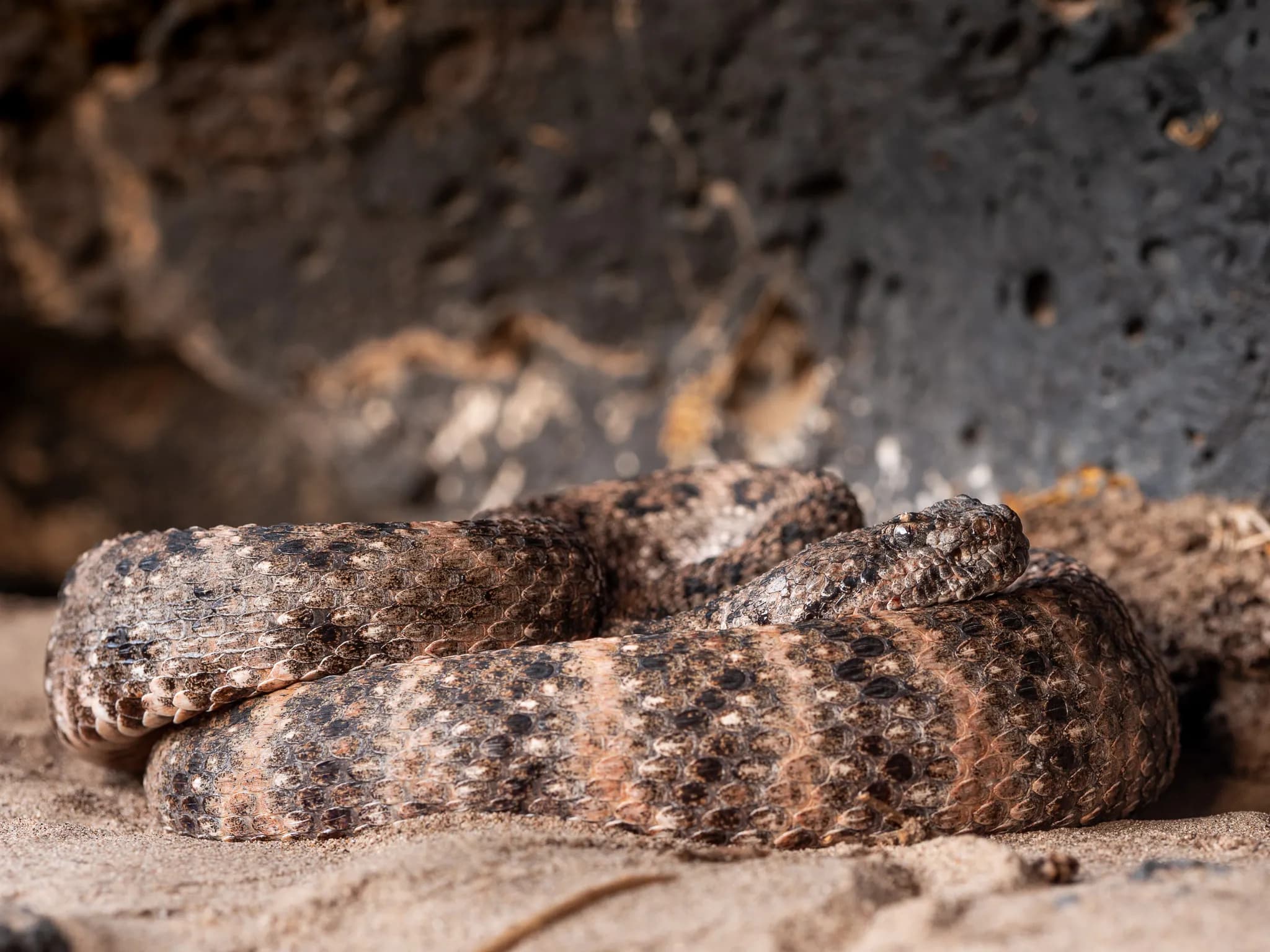
The main target of the day was, as you may have guessed, the lava speck - a southwestern speckled rattlesnake that has been subject to the selective pressures of the dark lava field and thus has a correspondingly dark pattern. Rock-affiliated as they are, specks do have a tendency toward local variation that roughly matches the rocks in their habitat and are quite variable in color, from orange to tan to nearly blue, with broadly similar color patterns depending on where they are found, as well as local variation. While specks were the main target, I am always happy to see all sorts of wildlife and particularly any kind of snake - and there are several interesting species in this area, including most of the regularly seen residents of this area, including sidewinders and shovel-nosed snakes. Always happy to see a snake in a new place.
I started with a general idea of that specks were present without much detail about where to find them. I had about 5 hours to look - not a ton of time, but enough to give it a go. Having picked out a spot to start, I drove as close as I could and started hiking in the early afternoon. It was hot, but not overwhelmingly so.
Lava rocks are surprisingly hard. As I navigated the jagged terrain I could feel the rocks testing the soles of my hiking boots with their rough edges and sharp points. While that was not the most comfortable experience, lava rocks do make for excellently grippy footholds.
I spotted several fast and dark side-blotched lizards as I walked. Most seemed as skittish as ever, darting off before I could get too close. One posed for me for a few seconds - you'll see its picture in this article.
In one rocky cove at the edge of the lava flow was a beautiful but sad sight - the bony carcass of a desert tortoise, picked over long ago now just a "shell" of its former self. Several hundred yards away, another shell, this one much further on in its disintegration - now reduced to small pieces.
A characteristically half-dome-shaped tortoise burrow was not too far away, though I couldn't tell if it was occupied. Tortoises construct and use multiple burrows - perhaps no one was home, or perhaps this particular home had a vacancy. I could find no obvious tracks around the entrance indicating the presence of an tortoise, but there were some other tracks I couldn't identify. Tortoise burrows form important habitat in the desert for other creatures - hopefully this one was in use.
After hiking around for about three hours, I stopped to eat my packed dinner as the heat of the afternoon began to dissipate.
Re-energized, I decided to switch things up and try another area. I'm not sure if it was the location, temperature, or time of day, or all three of these contributing to better luck in the latter half of the day, but I finally stumbled upon a buzzer-beater speck taking shelter under a small rocky overhang on a sandy substrate opening into a protected cove.
We sat together for a while and I took some photos. I couldn't get too close since I didn't want to spook into retreat, but I did manage to capture a few shots that captured its lovely pattern, with lovely blacks and pinkish-oranges that really do reflect its surroundings.
The snake looked pretty old, with parallel rattle segments and gnarled features. I wonder how long it's used this spot, and how long it will continue to do so. I hope it's found its next meal.
I very much look forward to further exploring this area and other areas nearby and maybe finding another resident - perhaps a tortoise, a sidewinder, or a shovel-nosed snake.