Columbia River Gorge, March 2025
March 3, 2025 · Columbia River Gorge
- Travel
When I saw I had a work-related event in the Columbia River Gorge, I decided to make the most of it by tacking on a few days of vacation at either end to explore the area with my family. We were there in early March, which turned out to be a great time to be there.
While I've never lived in the Pacific Northwest, I have backpacked extensively in Olympic National Park, which is notable for having both glaciers and rainforests, which is just such a cool combination to have in close proximity. Both of these natural features are the product of extreme rainfall in the region. Those trips were extremely formative and helped build my passion for the area. But I was not a herper at the time, which left a major hole to be filled. The Pacific Northwest holds a treasure trove of interesting herps.
The steep walls of the gorge forms where the majestic Columbia River cuts through the Cascade range. The gorge is a bit drier than the Olympic peninsula in terms of annual precipitation, but not by much. And of course water is everywhere. Impressive waterfalls form where tributaries enter the gorge -- the "cascades" is truly a fitting name. The river is the largest in the Pacific Northwest fed by an area roughly the size of France, extending through much of Washington, and Oregon and drawing water from as far as Wyoming and Alberta, Canada. This massive flow of water powers the Bonneville dam and a dozens of other upstream dams. Hundreds of thousands of fish, including salmon of many kinds, lamprey, and sturgeon, find their way up the fish ladder, which is worth a visit, particularly in the peak season. Fish at upstream dams may not be so lucky. Fish are plentiful enough to draw sea lions nearly 150 miles upstream to the Bonneville dam.
Oh, are you here for the herps? Right. I had several targets, most of which were salamanders. One of these was the coastal giant salamander - an impressive salamander and the largest terrestrial salamander in the continental US. Another particular target was the cascade torrent salamander - one of a really unique genus - Rhyacotriton - endemic to the PNW. I also hoped to see a few of the many plethodontid species in the area. I was also interested in seeing mountain kingsnakes, northern alligator lizards, and coastal tailed frogs, though [spoiler] none of those showed up for me this time.
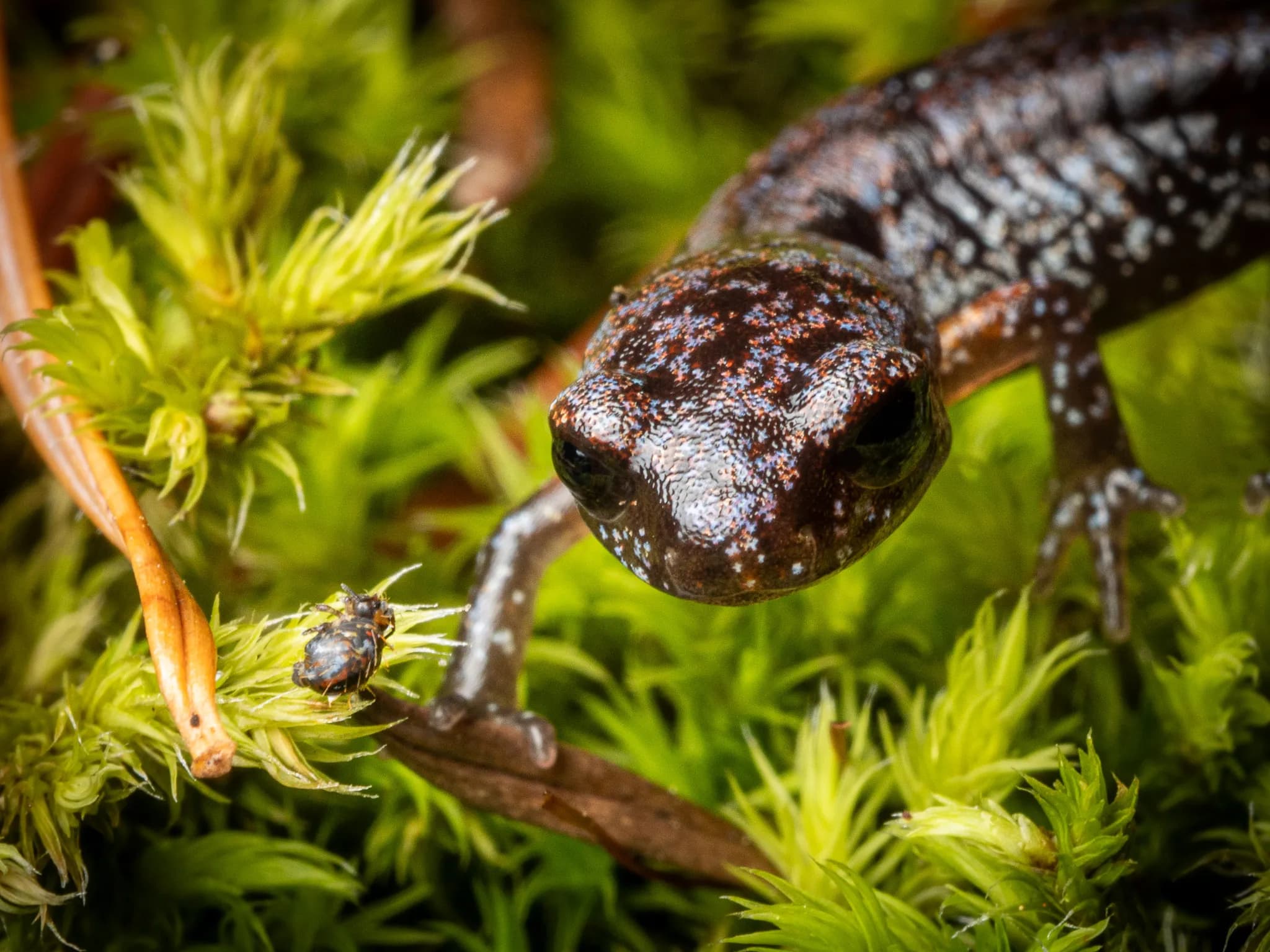
The night we arrived, I set out to find somewhere to take a night hike. I pulled into a small trailhead and was immediately met by several police officers who were parked there - I almost turned around and left because I thought they'd be prohibiting entry, but after a friendly chat, it turned out they were just hanging out and weren't there to stop anyone. Suitably reassured, I set out and hiked several miles through one of the "drier" forested areas. After a while encountered several fully terrestrial salamanders in pretty good numbers, including Oregon Ensatina and Western Red-backed Salamanders. Several of these were EXTREMELY tiny juveniles that would fit on the tip of your finger with room to spare. In ten square feet, where I sat to photograph these salamanders, I saw at least 4 individuals. I'm sure I was barely scratching the surface.
With the success of the prior night to bolster me, in the morning I took the kids for a hike in some riparian habitat and found an absolutely incredible neotenic adult Coastal Giant Salamander and a couple of cool looking Dunn's Salamanders. Both of these species favor habitat close to rocky streams. We didn't have too much time at that spot, but a few days later I went back at night and found a couple of Larch Mountain Salamanders, more dunn's salamanders, and many more juvenile giant salamanders in various stages of development.
The next day, work stuff picked up and kept me cooped up for a while. I couldn't complain because work had brought me out there in the first place, but boy was I eager to get back out in the field! That night I went out for another night hike and found another coastal giant salamander larva and a couple more ensatina.
After work stuff wrapped up, I tried targeting long-toed salamanders and ended up seeing snakes! It's always fun to see a large number of snakes. The red-spotted garter snake obliged us on one trip to a grassy area which seemed to be just teeming with them. We caught two at once and saw several others escape into brush as we passed by. These were beautiful snakes, not too bitey or musky, and especially fun for the kids to admire.
At this point I started to really hanker for one of two species - either a tailed frog or a torrent salamander. I targeted these for the rest of the trip and after several unsuccessful trips was eventually rewarded with a really nice spot for torrent salamanders in some beautiful and pristine creek habitat where they seemed plentiful. Torrent salamanders are very sensitive to water temperature (even a few degrees of warming can kill them) and water clarity, surviving only in cold, clear, silt-free streams. Not wanting to disturb too much of their delicate clear-stream habitat, we focused a search on a small area of no more than 4 square feet and turned up several individuals among the rocks at the slow-flowing edges of the stream. These derpy little fish-like salamanders are easy to fall in love with. And we must protect them. Logging in their habitat, including anywhere upstream, is a major threat to torrent salamanders, as dirt and silt from logging turns these streams into muddy tombs for these sensitive salamanders.
Unfortunately that was a wrap on the herping side of the trip, as we spent the rest of our time in Portland with some good friends who had moved to the area. We left many stones unturned on this trip, so to speak, and I look forward to a return to the Pacific Northwest to see more of the incredible diversity in the area. So much left to see.