Naming snakes for Project Rattlecam
Today Project Rattlecam went live again! So it seems as good a time as any to celebrate a minor accomplishment from last season.
Project Rattlecam is a webcam showing a Prairie Rattlesnake mega-den at an undisclosed location in Colorado, and it is hands-down the most fantastic live stream webcam of any wild animal I've ever seen. The subjects themselves are of course very interesting, but the technical cam setup is really top notch. During the active season, it's on 24/7 and during US waking hours there's almost always someone actively controlling it. The camera gives crystal clear images with incredible zoom and 360° pan. They can get so close to the animals with zoom that it is possible to see detailed views of tiny insects crawling around - enough to make species IDs. At night, the camera switches over into night-vision IR mode, showing what's going on after dark, even inside the den. Over the course of the season, thousands of snakes visit and use the den, including Western Terrestrial Garter Snakes and, of course, the main attraction: Prairie Rattlesnakes.
Snakes are a wonderful subject for a webcam. Some people don't want to get close to snakes. Putting a webcam between viewers and snakes helps to remove that fear and the close-up shots help to reveal the rattlesnakes in their most natural resting state. Many people are startled or frightened when they see a rattlesnake in person, and often rattlesnakes show a scary-looking defensive stance when they're stressed by a potential threat like a nearby human - rattling and hissing and posturing. It's nice to be able to show how relaxed and docile they are when they aren't being bothered. The denning behavior of these snakes also means that an incredible number of subjects show up and stick around. It's a fantastic idea to put a camera at the den.
If you haven't spent a few minutes watching the Project Rattlecam live stream, and you're coming across this between the months of April and November, go do that now. I'll wait.
While my wife was at a conference for a few days last summer, I found myself with lots of evening hours alone at home while the kids were in bed. I spent many of these hours watching the Project Rattlecam live stream, enjoying the active and delightful chat and admiring the snakes and other visitors to the den. I started learning the various names of the rocky features at the den, like the "clown car", and the "annex". As I watched, I started casually browsing the rattlecam site.
There I learned they've set up a page with all of the named, individually identified rattlesnakes (no individually-identified garters yet). The researchers who set up the camera have done some studies specifically on the identified, named snakes. This kind of bulk collection of individually-identified snakes seems like it could yield some really interesting patterns and observations about wild snake behavior. I'm not aware of any other ways to study individuals of a species in the wild in this way. It's a pretty remarkable opportunity.
It turns out that there's an ongoing challenge associated with Project Rattlecam, which is that if you can identify the exact same individual snake on three different days, you get to name it! Sounds fun, doesn't it!? And lots of people have done it, including now me! The rest of this is a walk-through of how I did it, in case you want to give it a try too and want to know where to start.
While many snakes pass through only occasionally, some snakes are seen repeatedly. Some of these snakes have distinctive or recognizable injuries, so they're relatively easy to recognize as they come on screen. Other snakes are recognizable by pattern alone. You can use these clues to find snakes that show up repeatedly.
At first, my goal was just to find one of the rattlesnakes that had already been named. This is a pretty fun exercise. It involves studying the named snakes and, whenever you see one come on screen, trying to figure out if it matches one of the patterns you see in their online registry of named snakes.
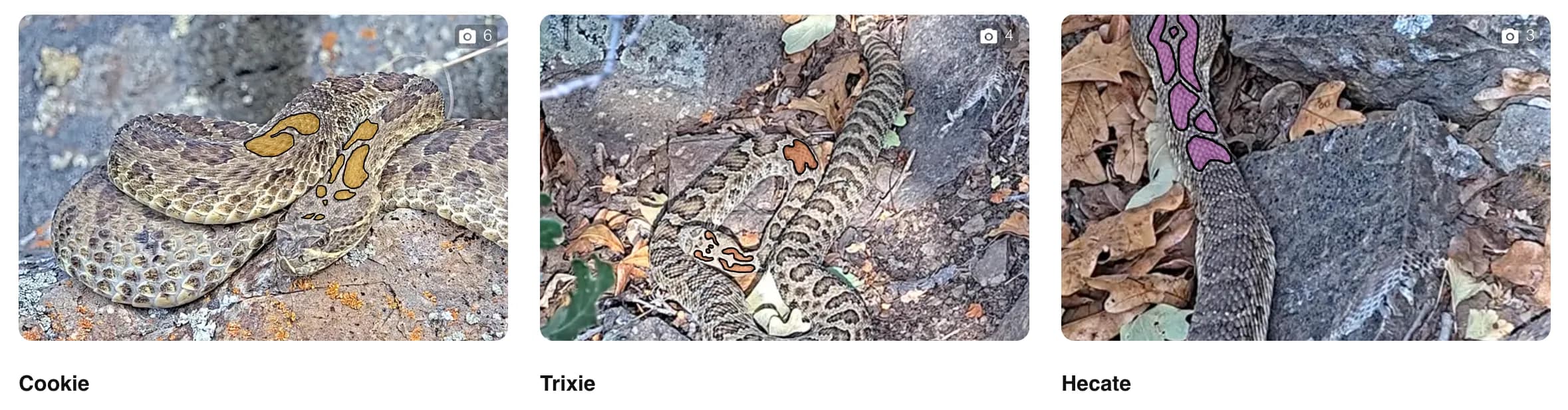
Identifying an individual snakes, even if you've got a picture of it in front of you, is tricky. One of the challenges is the vocabulary - how do you put into words descriptions of the patterns of the snake? Fortunately, at Project Rattlecam, they've developed (or tapped into) a vocabulary which fits the natural markings of the snakes. For instance, they talk about "headstamps" - referring to the distinctive patterns on the head and neck, and "saddles", referring to the darker amorphous but saddle-like patches that repeat down the length of the snake. Like fingerprints, each snake has a unique pattern, but sometimes the differences are quite subtle. Often a snake is most clearly identifiable by a combination of patterns, rather than one pattern alone. The researchers and students managing the site have a clever way of making this much easier, which is that they use some drawing program to color in and highlight the most distinctive patterns on a few select pictures of each named snake, so that if you see those distinctive patterns there's a very good chance you're looking at the same snake.
Even finding an existing named snake is slow-going. Nearly all of the rattlesnakes coming on screen are either unnamed, or don't have enough of the identifying patterns, markings, or scars visible make a positive ID. This was a little discouraging at first, but actually I think it is quite encouraging if you're trying to identify a new snake. There are so many possibilities!
With all this in mind, I set out instead to try to contribute to the set of named rattlesnakes by finding and naming my own rattlesnake. Thus began the process of combing through hundreds of hours of historical footage.
My main strategy was to start with historical recordings and fast forward through videos until I got to a snake which was showing its pattern in a way that made it possible to describe. These would often be top-down shots in which the headstamp and saddles were visible. I started just screenshotting these and putting them into a big document. I'd "harvest" these screenshots for a while, noting the date and time of each screenshot (easy, because they show it on screen, so I'd just include that in my screenshot), then when I'd collected all the screenshots I could from any particular video, I'd move on to categorizing.
When looking at the snake screenshots, I'd categorize by headstamp pattern or saddle connectedness. Identifying snakes feels a lot like starting on a 1000 jigsaw piece puzzle. If you like jigsaw puzzles, you'll probably like this challenge as well. If you've done a lot of puzzles, you'll know that one of the best ways to start is by identifying edge pieces. These have a unique property (a flat edge) which vastly reduces the search space for possible matches. Similarly, I'd try to identify some feature and group the snakes by that feature, to reduce the search space. These ones have connected headstamps, and these ones have disconnected headstamps. These ones have a a connected 12th and 13th saddle, and these ones have a connected 6th and 7th saddle. This snake has a heart-shaped shape after the 3rd saddle. This one has a dot between the 4th and 5th saddles, and so on. With only a few of these easily recognizable categories it was relatively easier to find matches within a particular category than across the whole population.
Predictably, some snakes had patterns that were more difficult to categorize. Some I didn't even screenshot because the webcam never showed enough identifying pattern. All these I just ignored or put in a category of their own.
After a LOT of searching, I finally got a match - two screenshots of the same snake, on different days! I ended up with several two-sighting snakes before I got a single three-sighting snake - but I eventually achieved this as well - and once I hit a critical density of categorized snake screenshots, it became easier to find new individuals showing up repeatedly.
In the end, I found and named 7 snakes! Dottie, Ivy, Hecate, Trixie, Cookie, Lyra, and Tweezers (who ended up giving birth on camera!!). One of my submissions was a match for a previously-named snake, Frida, which I missed because it hadn't been added to the website yet. They were nice enough to give me partial credit.
The next time I pick this up, maybe I'll vibe-code a more sophisticated labeling and review system to help me surface more matches. If you're a Rattlecam researcher and would be interested in something like this, drop me a line!